

The final scoreline in the Presidents Cup read USA 17 Internationals 13.
So, another comfortable win for the United States in this notoriously lopsided sporting contest – if it can even be called a contest? Well, no, not quite. Brandt Snedeker (above), the American captain, was very relieved to be able to hoist aloft the Presidents Cup at the conclusion of play.
The ole spanner had been well and truly thrown into the works on Friday when the International side had won all five foursomes matches thus assuming a lead they were not destined to relinquish until late in the singles on Sunday afternoon. So, ultimately it was a BBU – a brave but unavailing effort that promised so much but just fell short at the line.
I had not intended to watch much of the golf at the weekend because, frankly, it didn’t capture my attention but with the Internationals holding a three-point advantage with only the singles remaining I changed my tune. In so many ways I wish I hadn’t.
The first two singles matches were shared one apiece and America won the third one. The remaining nine matches all went to the 17th or 18th greens but the Internationals managed only one victory and one halved match. It was close…..but it wasn’t, if you know what I mean.
It’s never a good watch when there’s so much unedifying behaviour and lack of sportsmanship on display from the galleries. What is worse, however, and more worrying, is the seeming acceptance from the powers-that-be that this is ok. I certainly didn’t see or hear of any attempts to eject any of the perpetrators who were hell-bent on gaining the home side any advantage they could.

“There’s no place for that,” was Scheffler’s response to being asked about fan behaviour during his singles match in the Presidents Cup. [PGATOUR.com]
It was commonplace for loud applause and cheering to break out the minute an International approach shot found a greenside bunker or a tee shot was trouble-bound. Whatever happened to just being silent? I remember those days well and I also remember there being a respectful pause before partisan galleries would then cheer their own players loudly in an attempt to spur them on to victory. Boy, I’d love to get back to that.
I spent many years and many majors, the majority of them in the States, tramping along inside the ropes and in very close proximity indeed to the galleries. The Ryder Cups, of course, are emotionally turbo-charged and that is where I remember the first serious flashpoint occurring. I was out covering the top singles at Hazeltine in 2016 with Patrick Reed and Rory McIlroy embroiled in an epic battle, each playing scintillating golf over the first seven holes. When we were on the walkway from the 7th green to the 8th tee a spectator shouted abuse right into Rory’s face and McIlroy halted mid-stride, eyeballed the fan, pointed him out to the security people and promptly had him evicted. This was unprecedented in golf at the time.
Look where we are a decade later.

Mayhem on the 8th green at Hazeltine and Rory was fit to burst. Moments earlier he had had an abusive fan removed from the property. [Ryder Cup Youtube]
I shouldn’t really be surprised, though. Golf is an industry with zero history of acting upon anything in a timely fashion, never mind being ahead of the curve. There’s little evidence of anticipatory skills amongst the game’s guardians.
In the matter of technology, for example, we have known for decades that the clubs are cutting edge and to some extent skill-negating while the ball travels much too far. Roll back is essential to keep some of our older, great courses meaningful in the modern era and to keep rounds from becoming even more of a snooze-fest as players are required to traverse an increasing number of stadium-like courses with vast distances between green and tee. There is increasing evidence, too, that the imminent proposed roll-back is unlikely to achieve its desired effect – so……..back to the drawing board?
The perennial problem of slow play has never been seriously tackled either and there seems little real willingness to take the players on and do so – not helpful if your mission is to increase the numbers introduced to and captivated by this great game. And of course we have the growing problem of crowd behaviour and the very real prospect of it influencing the outcome of some of our greatest events.
What bugs me, though, is we’ve known about all of these issues for years and years. Take the Ryder Cup, for example. Why is alcohol on sale from 7.30 in the morning? Why are perpetrators of foul and abusive behaviour not immediately ejected and served with a life ban? Why are are all our actions reactive and not proactive? We’ve been able to see what’s coming down the track for a long, long time yet nothing has been done. It leads me to believe that any action that may affect the bottom line is unlikely to be forthcoming.
Last weekend a player’s shot was entirely influenced by a supporter of the opposing side. We saw that in spades last year at Bethpage Black in the Ryder Cup. This time Scheffler conceded a long putt to his opponent to redress the balance and he has been lauded as a great sportsman. Well, I would expect any decent human being to do as Scottie did. What is WRONG with people that they hold up his action as being so commendable? It used to be normal, it used to be expected.
Is this behaviour cultural, I wonder, or is it generational? Probably a bit of both. One thing it is not is acceptable – and neither is this sustained lack of action acceptable. It sends the message that everything’s ok and this is just a bit of high-spirited banter from committed fans. I know where I’d commit them.
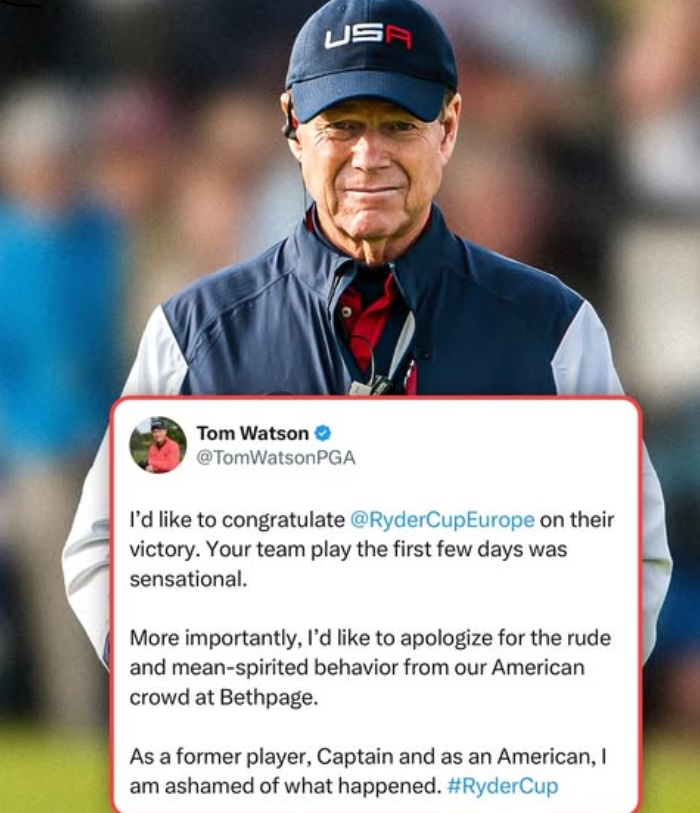
Five-time Open champ, Tom Watson, took to social media to express his feelings about the behaviour of the fans at Bethpage Black’s Ryder Cup last year. [ryder cup europe fb page]
It’s imperative those in charge make a concerted attempt to stuff this particular genie back in the bottle.


