Madill Golf - Two Sisters. One Sport. One Passion.
  • Home
  • Our Journey
  • People
  • Tournament Travels
    • The Masters 2016
  • Coaching
  • Other Stuff
Madill Golf - Two Sisters. One Sport. One Passion.
Home
Our Journey
People
Tournament Travels
    The Masters 2016
Coaching
Other Stuff
  • Home
  • Our Journey
  • People
  • Tournament Travels
    • The Masters 2016
  • Coaching
  • Other Stuff
Other Stuff

Golf, The Olympics And Herr Hitler’s Huff

The trophy, looking peachy, in its cabinet at Hesketh, photo by Alex Ridley

The trophy, looking peachy, in its cabinet at     Hesketh, photo by Alex Ridley

The Hitler Trophy:  Golf and the Olympic Games by Alan Fraser, published by Floodlit Dreams.


This is stirring stuff, a book that rattles along covering all sorts of ground as it examines the history of golf in and (mostly) out of the Olympic Games and traces the sometimes tortuous journey of a unique trophy, which is now proudly displayed in the Bentley Room at Hesketh Golf Club in Southport, Lancashire.  The detective work involved is  impressive and the characters involved, both ancient and modern, are compelling.

Alan Fraser, the author, is a Scot who has written about sport, golf in particular, for many years, covering every Open Championship from 1978 – 2014 and the Olympics in Barcelona, Atlanta, Sydney, Athens, Beijing and London.  He sets the stage for golf’s return to the Olympics in Rio this summer and perhaps the only new thing under the sun is the stringent drug testing that the golfers will have to undergo.  Rows, withdrawals, worries about half-completed venues, they’re an Olympic staple.


The author, right, launching his book at the BMW PGA Championship at Wentworth

The author, right, launching his book at the BMW PGA Championship at Wentworth

This year, viruses permitting, there will be 60 men and 60 women competing, separately, in a 72-hole individual event. The likes of Jordan Spieth, Rory McIlroy and Danny Willett will be trying to emulate Charles Sands, of Yonkers, New York, who won the gold medal in Paris (the course was at Compiegne) in 1900 over 36 holes and George Lyon, of Canada, who won in 1904 in St Louis.  He turned up to defend his title in London in 1908 but no other golfers pitched up and Lyon declined to accept the gold medal by default.

In 1900, Peggy Abbott, an American socialite who played at the Chicago Golf Club and had spent time in Paris studying art with Degas and Rodin, won the 9-hole women’s event.  The medals, however, were awarded retrospectively and she died in 1955 not even knowing that she was an Olympian let alone the first American woman to win a gold medal!

In 1904, the women were banned altogether and Pierre de Coubertin, the founder of the modern Games, was vehemently against any female participation, calling it “incorrect, unpractical, uninteresting and unaesthetic”.  Wonderful stuff.

The Hitler Trophy, more correctly the Golfpreis der Nationen, Gegeben Vom Fuhrer und Reichskanzler (donated by the Fuhrer and Chancellor of the Reich, Adolf Hitler), was contested in Baden-Baden in 1936, just after the Olympics in Berlin.  Seven two-man teams played 72 holes of strokeplay over two days, lowest combined total to win.

England, represented by Tom Thirsk, a Yorkshireman who played at Bridlington and Ganton and Arnold Bentley, a Lancastrian from Hesketh, were the winners.  France were second and Germany were third.  The hosts had been doing well enough for Hitler, allegedly, to set off for Baden-Baden to present the trophy but he was headed off and, allegedly, huffed his way home!

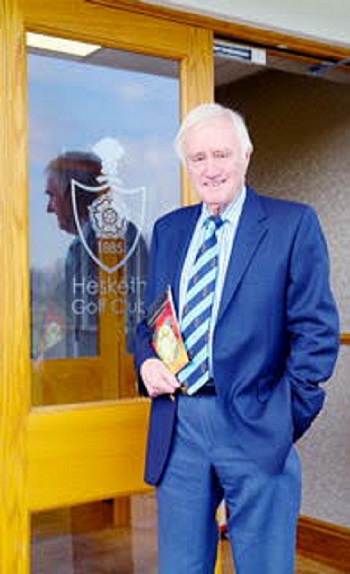
Read the book to learn more about Thirsk and Bentley, both fascinating characters, the Hitler Tree and how Derek Holden, pictured below, photo by Alex Ridley, helped secure the trophy for Hesketh.
Hitler book 2


May 27, 2016by Patricia
Coaching

The Challenges Of County Coaching

Cheshire County Captain Paula Latham (2nd left) and her support team

Cheshire county captain Paula Latham (second left) and her support team


The Coach’s View

Coaching is fun.  Coaching is challenging.  Coaching is a huge responsibility.  And I would place coaching at county level right up there at the top of the challenge mountain.

Why?  Because traditionally a county squad encompasses players of varying ages, skills and physical abilities.  Commitment and motivation usually vary enormously across the group.  We have the young promising teenager who has set her sights on an international cap, followed by a life on one of the professional tours.  There’s a 20 or 30-something year old who put her golf on hold to concentrate on career, family or both.  Finally, there is the older, steady, club player whose game seldom varies, has never had a lesson in her life and enjoys a gin and tonic or two.  Obviously, a one-size-fits-all approach simply won’t do.

This year's Champ, Lucy Jamieson

This year’s champ Lucy Jamieson

Whenever I’m faced with this eclectic mix, I try to provide a good deal of general, sound, basic knowledge and reinforce that with individual advice after ascertaining how much the player herself does or doesn’t know.  The last thing I want to do is overload the player and put her in a straitjacket of overthinking.

New talent, Megan Sumner

New talent Megan Sumner

Recently, I had the pleasure of coaching a squad of Cheshire county players in preparation for Northern County Match Week at Penrith Golf Club next month.  We kicked off the session by doing a lot of fun balance exercises that I have found beneficial over the years.  Through exploration and experimentation players discover that there IS a great deal of movement in the golf swing but if the centre of gravity is contained within the stance, their ball-striking is greatly improved.  The only time “being still” is beneficial is arguably when you’re putting, yet so many players mistakenly try hard not to move too much on the big swing.

Long serving and multi capped player, Jeanne Bell

Long-serving,  multi-capped Jeanne Bell

Part of my brief included work on the short game.  I asked the players to play 25-yard pitch shots with a sand iron to a tight pin.  Most were reasonably adept, as you would expect but many lacked the touch and feel of really proficient short-game players.  I have always contended that it’s difficult to video what really makes a player great – the pace of the swing through the ball, the amount of tension in the arms, things that you can’t easily see.  Concentrating on these feelings changes the flight of the ball and the speed at which it comes off the clubface.  Another dimension of feel, a softness, can elevate a player’s short game, which is very important when that player faces fast, firm greens in big championships.

Bearing in mind that a number of your squad of county players will have their own individual coach, it is imperative not to run counter to that coach’s work and confuse the player.  For me, imparting knowledge in an enjoyable, engaging manner that encourages questions and learning is what it’s all about.  So, do I love or loathe county coaching?

I love it!  Bring it on!

May 27, 2016by Maureen

Subscribe to Madill Golf

Enter your email address to subscribe to our blog and receive notifications of new posts by email.

Follow Maureen on Twitter

My Tweets

Follow Patricia on Twitter

My Tweets

Search Madill Golf

Share us with your golfing friends

Share on facebook
Facebook
Share on pinterest
Pinterest
Share on twitter
Twitter
Share on linkedin
Linkedin

Recent posts

The Eyes Have It

The Eyes Have It

One Of Our Own

One Of Our Own

Playing To The End

Playing To The End

Lest We Forget

Lest We Forget

Hanging By A Thread

Hanging By A Thread

Follow me on Twitter

My Tweets


Madill Golf Logo

Archives

Categories

© 2016 Copyright Madill Golf // Imagery by John Minoprio // Website design by jdg.
Loading Comments...